Here’s the finished board from this Datadog Illuminated episode on how to use AI to find security flaws in static code. It walks through the two-pass check that cut false positives and got Datadog’s OWASP score up 50%, a fast/cheap LLM screen followed by a deeper reasoning pass. If your own security scanner drowns developers in alerts they no longer trust, this shows a way out.

Read the full board notes here: gist.github.com/wiggitywh…
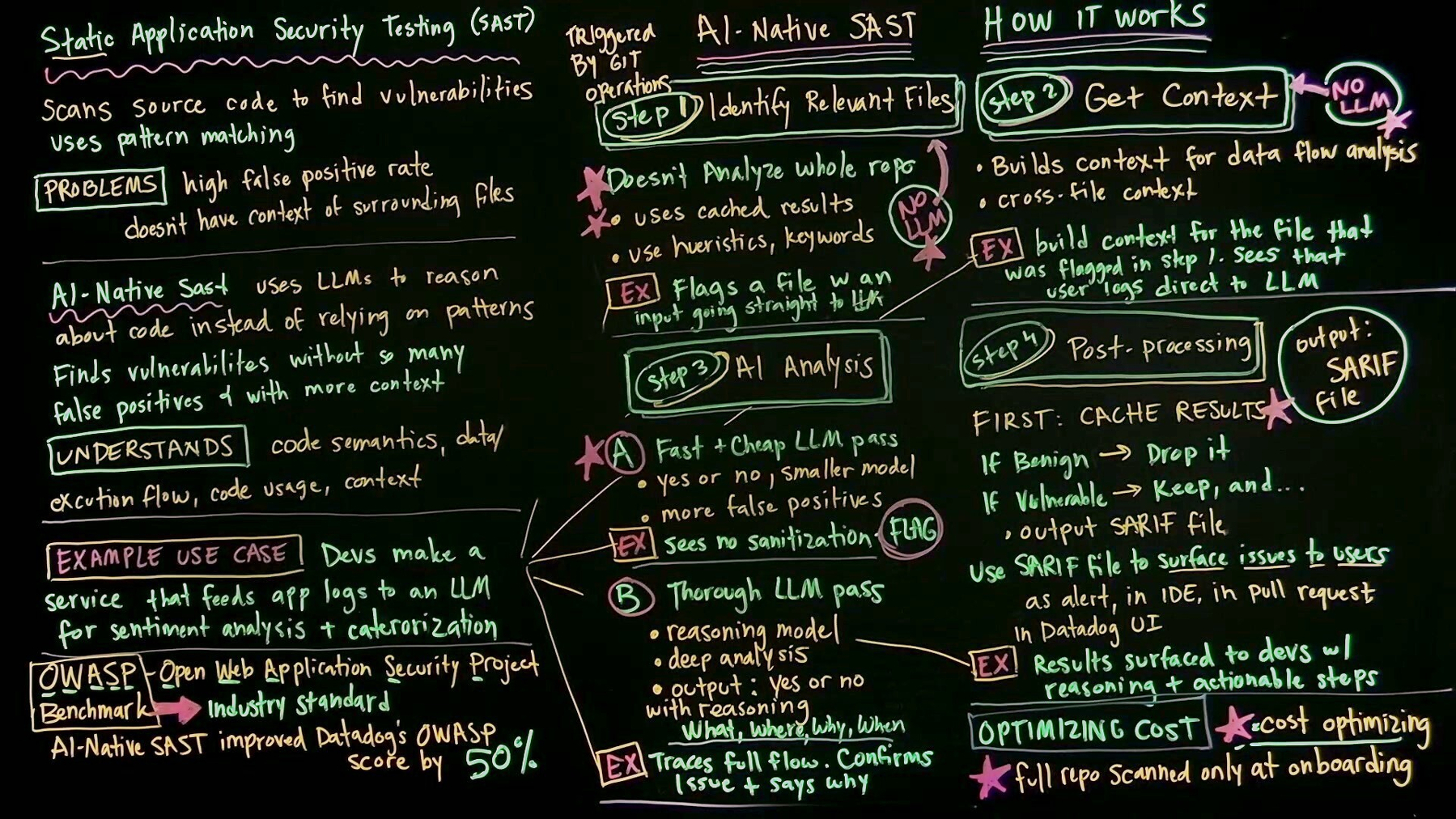
A three-column lightboard diagram in green, yellow, and pink chalk marker on a black background. The left column, "Static Application Security Testing (SAST)," lists its problems (high false positive rate, no context of surrounding files) and contrasts it with "AI-Native SAST," which understands code semantics, data and execution flow, code usage, and context, with an example use case and a note that AI-Native SAST improved Datadog's OWASP score by 50%. The middle column, "AI-Native SAST," triggered by Git operations, shows Step 1 (Identify Relevant Files) branching into Step 3 (AI Analysis), split into a fast/cheap LLM pass (A) and a thorough reasoning-model pass (B), each with an example. The right column, "How It Works," shows Step 2 (Get Context, no LLM) and Step 4 (Post-processing), which caches results, drops benign findings, and outputs a SARIF file used to surface issues to developers in IDEs, pull requests, and the Datadog UI, alongside a note on optimizing cost by only scanning the full repo at onboarding.